Lynnity Knowledge Hub
PersonalisedSupplementAnswers forBetter WellnessDecisions
Short, structured articles that explain supplement customisation, liposomal nutrients, herbosomal botanicals and quality-controlled formulation in answer-friendly language.
Lynnity Clinical Journal
Practitioner guides & patient answers
Structured, pharmacist-written articles on compounding, hormones, clinical nutrition and delivery science. Filter by topic, then open any guide to read in full.
 Supplements
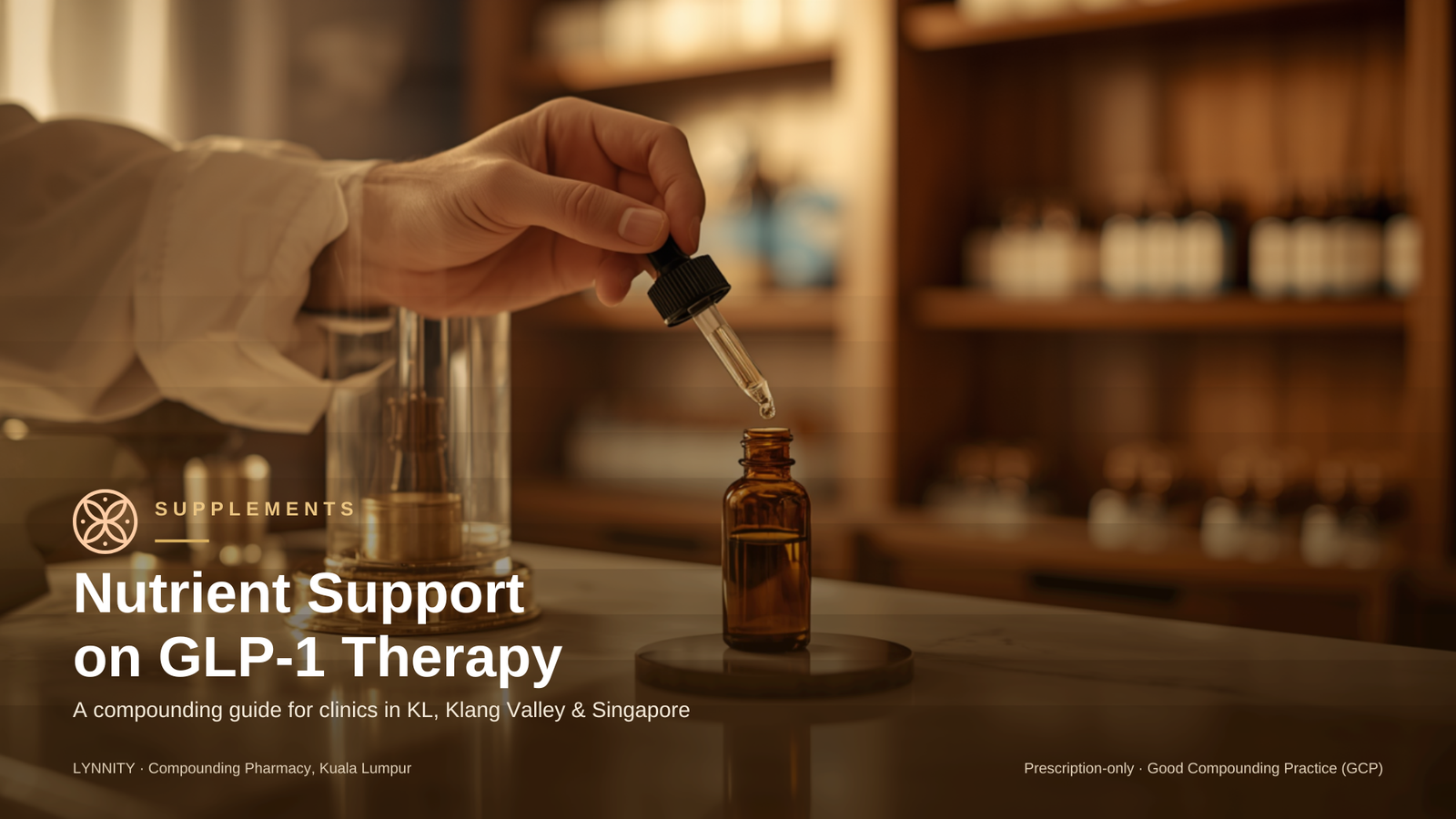
Nutrient Support for Patients on GLP-1 Therapy: A Compounding Guide for Malaysian Clinics
Patients on GLP-1 receptor agonist therapy eat considerably less, often eat a narrower range of foods, and digest more slowly — and that combination leaves measurable nutrient gaps…Read the guide Supplements
Compounded Liposomal Resveratrol in Malaysia: A Practitioner's Guide for Longevity and Healthy-Ageing Clinics
Resveratrol is a plant polyphenol — a stilbene concentrated in grape skins and Japanese knotweed — best known in the longevity field as a sirtuin…Read the guide Supplements
Compounded Liposomal Quercetin in Malaysia: A Practitioner's Guide to Bioavailability, Mast-Cell Support and When It's Prescribed
Quercetin is one of the clearest examples in the supplement world of a promising molecule held back by poor delivery. It is a flavonoid that dissolves…Read the guide Supplements
Compounded Liposomal Curcumin in Malaysia: A Practitioner's Guide to the Bioavailability Problem, Formulation and Dose
Curcumin is the textbook example of a good molecule with a bad delivery profile. It is strongly fat-soluble and almost insoluble in water, it is…Read the guide Compounding
Liposomal and Skin-Identical Creams: Why the Delivery Base Decides What a Compounded Topical Actually Does
In a topical preparation, the base is not inert packaging around the active — it is the single biggest determinant of whether the active ever reaches…Read the guide Supplements
Precision Supplement Formulation: Why the Pharmacy Shelf Cannot Match a Blood Test
A shelf supplement is a fixed dose in a fixed combination, formulated for a population average before anyone knew a single one of your patient's…Read the guide Compounding
It May Not Be the Drug. It May Be the Filler.
When a patient reacts to a medicine or supplement, the active ingredient is not always the culprit. The reaction may be to an excipient — a filler,…Read the guide Supplements
Compounded Liposomal Vitamin C in Malaysia: A Practitioner's Guide to the Absorption Ceiling, G6PD Screening and Dose
Vitamin C has an absorption ceiling that most prescribing conversations ignore. Uptake from the gut runs through a saturable sodium-dependent…Read the guide Supplements
Personalised Inositol Compounding for PCOS and Metabolic Clinics: Getting the Myo/D-Chiro Ratio, Dose and Form Right
Inositol — most often the pairing of myo-inositol and D-chiro-inositol — is one of the most commonly discussed supplements in polycystic ovary syndrome…Read the guide Supplements
Personalised Vitamin D Compounding: Matching Dose, the D3–K2 Pairing and Delivery Form to the Patient
Vitamin D insufficiency is surprisingly common in Malaysia despite the tropical sun — some Klang Valley studies have reported a majority of adults…Read the guide Supplements
Personalised Iron Compounding: Choosing a Form and Dose for Patients Who Can't Tolerate Standard Iron
Oral iron is one of the most poorly tolerated supplements in everyday practice — surveys report that around 40% of people on standard-dose oral iron…Read the guide Supplements
Personalised Berberine Formulations in Malaysia: A Compounding Guide for Metabolic and Integrative Clinics
Berberine is a plant alkaloid that has become one of the most-asked-about supplements for metabolic and blood-sugar support, but it has two practical…Read the guide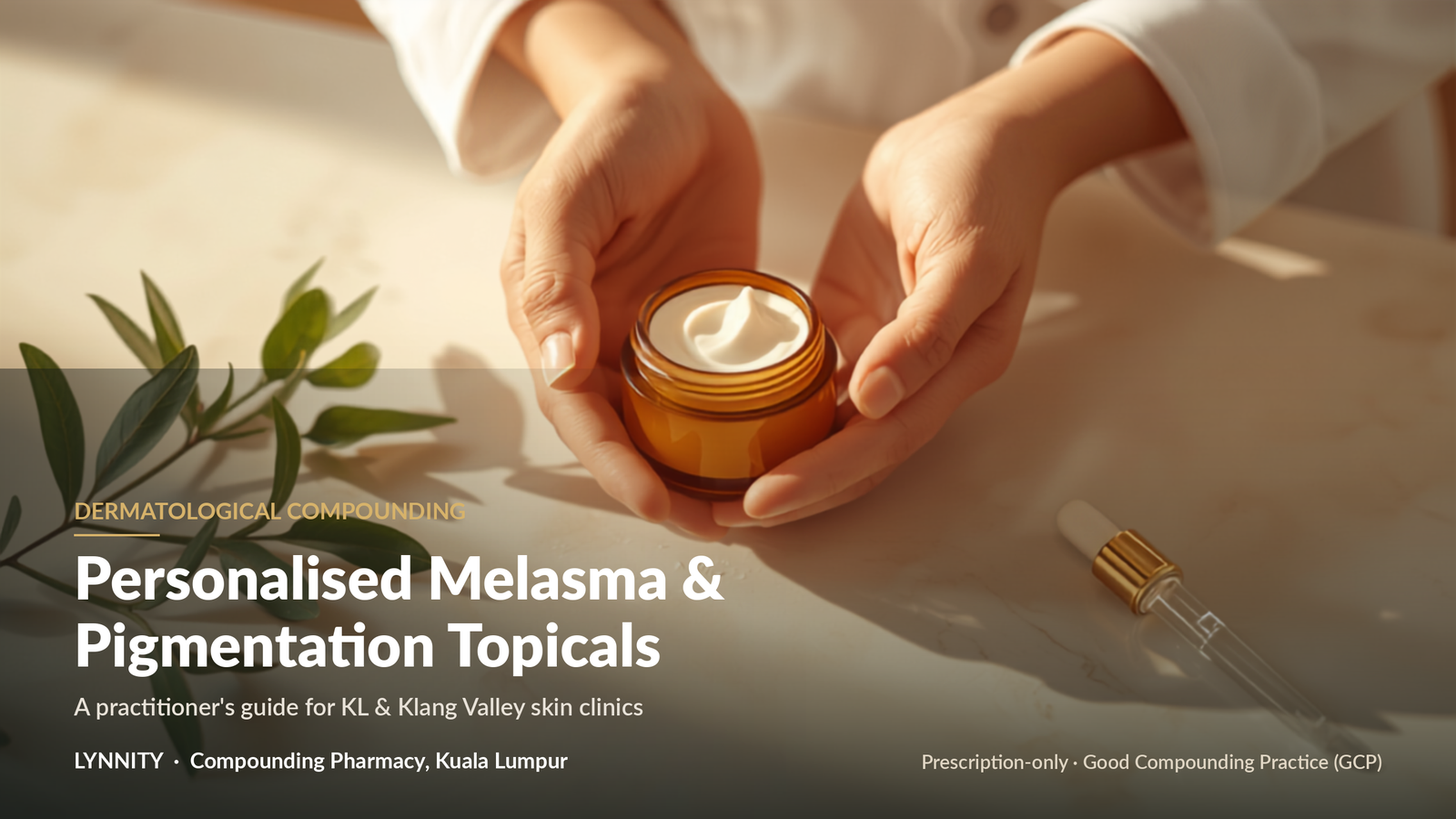 Compounding
Compounded Melasma and Pigmentation Topicals in Malaysia: A Practitioner's Guide to Personalised Formulations
Melasma and stubborn facial pigmentation are usually managed with a combination of topical actives — hydroquinone, tretinoin and a mild corticosteroid…Read the guide Compounding
Compounded Eczema & Sensitive-Skin Topicals: Barrier-Repair and Excipient-Aware Formulations for Clinics
A compounded eczema or sensitive-skin topical is a cream, ointment, gel or lotion made to one patient's prescription — the exact actives, strengths and…Read the guide Hormones & BHRT
Perimenopause and Compounded Hormone Support: A Practitioner's Guide for KL & Singapore Clinics
Perimenopause is the transition of several years before the final period, when hormones do not simply decline but fluctuate — oestrogen can swing high…Read the guide Hormones & BHRT
Compounded Erectile Dysfunction Formulations: A Compounding Guide for Men's Health Clinics
A compounded erectile-dysfunction (ED) formulation is a preparation made to one patient's prescription using an active a doctor selects — most often a…Read the guide Supplements
Personalised Zinc Compounding for Clinics: Choosing the Right Form, Dose and Copper Balance for Each Patient
Zinc is sold in many chemical forms — bisglycinate, picolinate, citrate, gluconate, sulphate, acetate and oxide — and they are not interchangeable…Read the guide Supplements
The Science of Liposomal Delivery
Liposomal delivery represents a profound leap forward in nutritional science, fundamentally changing how our bodies absorb and utilise…Read the guide Hormones & BHRT
Progesterone, Oestrogen and Testosterone: A Compounding FAQ
Progesterone, oestrogen and testosterone are the three hormones most often prepared as personalised, compounded formulations. A…Read the guide Hormones & BHRT
Bioidentical vs Synthetic Hormones: What’s the Difference?
The difference is chemical structure. Bioidentical hormones have the same molecular structure as the hormones your body makes…Read the guide Hormones & BHRT
Compounded Thyroid Medication in Malaysia: What It Is and When a Doctor Might Prescribe It
Compounded thyroid medication is a thyroid preparation made to order for one patient, in the exact strength and form a doctor…Read the guide Compounding
Is a Compounding Pharmacy Safe? Understanding Good Compounding Practice (GCP) in Malaysia
A compounding pharmacy is safe when it prepares medications only on a doctor’s prescription and works to recognised quality standards.…Read the guide Compounding
Personalised Medicine Explained: How a Compounding Pharmacy Tailors Your Formulation
Personalised medicine means a medication prepared to fit one patient rather than a one-size-fits-all pack. A compounding pharmacy…Read the guide Compounding
Customised Supplement Formulations for Clinics: How Practitioners Partner With a Compounding Pharmacy
A customised supplement formulation is a nutritional preparation compounded to one patient’s requirements — the exact actives,…Read the guide Compounding
Dermatological Compounding in Malaysia: Custom Topical Formulations for Skin and Aesthetic Clinics
Dermatological compounding is the preparation of a topical medication — a cream, gel, lotion, ointment or solution — made to one…Read the guide Hormones & BHRT
Compounded Testosterone & Men’s Hormone Formulations in Malaysia: A Compounding Guide for Andropause and Men’s Health Clinics
A compounded testosterone or men’s hormone formulation is a preparation made to one patient’s prescription — the exact hormone,…Read the guide Compounding
Nutritional Compounding: Combining Multiple Supplements Into One Capsule — A Guide for Clinics Reducing Patient Pill Burden
Nutritional compounding is the preparation of several nutrients — vitamins, minerals, amino acids, botanical extracts and similar…Read the guide Supplements
Methylated B Vitamins and MTHFR: Personalised Methylfolate & Methylcobalamin Compounding for Clinics
Methylated B vitamins are B vitamins supplied in their already-active forms — methylfolate (5-MTHF) instead of folic acid, and…Read the guide Supplements
Personalised Magnesium Compounding: Choosing the Right Form and Dose for Each Patient
Magnesium is sold in many different chemical forms — glycinate, citrate, malate, taurate, L-threonate, oxide and others — and they are…Read the guide Compounding
Compounded Melatonin for Clinics: Personalised Doses and Delivery Forms in Malaysia
Melatonin is a hormone the body makes to signal night-time, and as a medicine it is used chiefly to help with the *timing* of sleep —…Read the guide Compounding
Compounded Hair-Loss Formulations: Topical Minoxidil–Finasteride for Clinics in Malaysia
A compounded hair-loss formulation is a topical preparation — usually a solution, foam or spray applied to the scalp — made to one…Read the guide Supplements
Compounded Liposomal Glutathione: A Practitioner’s Guide for Clinics in Malaysia
Glutathione is the body’s principal intracellular antioxidant, and it is one of the most-asked-about ingredients a clinic in Malaysia…Read the guide Hormones & BHRT
Compounded DHEA in Malaysia: A Practitioner’s Guide for Hormone, Menopause & Fertility Clinics
DHEA (dehydroepiandrosterone) is a steroid hormone made by the adrenal glands and a precursor — a building block — the body converts…Read the guide Supplements
Compounded Liposomal NAD+ Precursors (NMN & NR) in Malaysia: A Practitioner’s Guide for Longevity and Wellness Clinics
NAD+ (nicotinamide adenine dinucleotide) is a coenzyme every cell uses for energy metabolism and DNA repair, and its levels fall with…Read the guide Supplements
Personalised CoQ10 and Ubiquinol Compounding in Malaysia: A Practitioner’s Guide
Coenzyme Q10 (CoQ10) is a fat-soluble compound the body makes itself and uses in the mitochondrial machinery that generates cellular…Read the guide Compounding
Low Dose Naltrexone (LDN) Compounding in Malaysia: A Practitioner’s Guide to Prescribing and Formulation
Low dose naltrexone (LDN) is naltrexone prescribed at a small fraction of its standard dose — usually in the range of about 0.5 mg to…Read the guide Compounding
Compounding Pharmacy vs Retail Pharmacy: What’s the Difference?
A retail pharmacy dispenses ready-made medicines exactly as the manufacturer produced them; a compounding pharmacy prepares a…Read the guide Compounding
Paediatric Compounding in Malaysia: Custom Doses and Flavours for Children
Yes — a compounding pharmacy can prepare a child’s medication in an easier-to-take form, a child-friendly flavour, or a precise dose…Read the guide Hormones & BHRT
Topical vs Oral Compounded Hormones: Which Form Is Right for You?
The difference between topical (cream or gel) and oral (capsule) compounded hormones comes down to how the hormone enters your body —…Read the guide Hormones & BHRT
Menopause and BHRT in Malaysia: A Guide for Women Considering Bioidentical Hormone Therapy
Bioidentical hormone replacement therapy (BHRT) is a personalised form of hormone therapy that uses hormones with the same molecular…Read the guide Hormones & BHRT
BHRT in Malaysia: What Bio-Identical Hormone Therapy Is and How to Get Started in KL
What BHRT is, who considers it, and how to get started in KL: doctor consultation, patient-specific prescription, then a personalised…Read the guide Compounding
How to Get a Prescription for Compounded Medication in Malaysia
Step-by-step guide to getting compounded medication in Malaysia: see a registered doctor, get a patient-specific prescription, and…Read the guide Supplements
Liposomal vs Standard Supplement Formulations: What’s the Difference?
Liposomal vs standard supplements: how phospholipid delivery works, which nutrients benefit, and how Lynnity KL compounds customised…Read the guide Compounding
What Is a Compounding Pharmacy? A Guide for Patients in Malaysia
What is a compounding pharmacy? A registered pharmacist prepares customised medication to your doctor’s prescription. How it works i�Read the guide Compounding
A Pharmacist’s Guide to Evening Wind-Down
Non-pharmacological habits + compounded options for the patient whose sleep needs more than just supplements. By a Pharmacy Board of…Read the guide Compounding
Compounded Men’s Wellness Options Explained
When custom-dose compounded formulations make sense for men’s wellness — sublingual troches, daily-low-dose protocols, combination…Read the guide Compounding
Compounded Pigmentation Care for Malaysian Skin
Modified Kligman, tranexamic acid, cysteamine — what actually works for melasma and pigmentation in tropical-climate Fitzpatrick III–V…Read the guide Compounding
Compounded Pain Cream for Diabetic Nerve Discomfort
How topical multi-active formulations target peripheral nerve pain with much lower side-effect burden than oral therapy.Read the guide Compounding
Why Cats Can’t Take Paracetamol — And What Compounding Solves
A single human paracetamol tablet can kill a cat. The biology behind species-specific medication risks, and how veterinary compounding…Read the guide Compounding
A Pharmacist’s Guide to Compounded Sleep Support
How custom-dose melatonin, sustained-release formulations, and combination compounds help with sleep onset and maintenance — when…Read the guide Compounding
Topical Compounded Hair-Growth Treatment Explained
Why topical compounded formulations are gaining ground over oral therapy — evidence, dosing, side-effect comparison, and how to start.Read the guide Supplements
Liposomal Vitamin C vs Standard Vitamin C — What the Studies Show
Does liposomal vitamin C actually absorb better than standard ascorbic acid? The plasma data, the saturation problem, and when each is…Read the guide Hormones & BHRT
Is Bioidentical Hormone Therapy Safe? An Evidence-Based Look
A clear, evidence-based look at compounded BHRT safety — what the data shows, what it doesn’t, and who should be cautious.Read the guide Compounding
Compounding Pharmacy vs Retail Pharmacy — What’s the Difference?
A retail pharmacy dispenses mass-produced drugs. A compounding pharmacy makes one prescription for one patient. Here’s when you need…Read the guideNext step
Ready to talk about a personalised supplement direction?
Return to the homepage contact section or contact Lynnity directly.