
Medically reviewed by: Vitthia Rama Murti, BPharm Hons (University of Cyberjaya), RPh 15632 — Chief of Staff & Compounding Pharmacist, Lynnity Compounding Pharmacy.
Last reviewed: 27 May 2026.
Page body
Liposomal encapsulation, explained
Most of what you swallow doesn’t reach your bloodstream. The walls of the stomach and small intestine are designed to keep things out. Most water-soluble vitamins, when taken above a modest dose, are absorbed at saturating efficiency well under 100%, and then excreted. Liposomal encapsulation is one of the few practical solutions: it wraps the active in a microscopic phospholipid sphere, which the gut wall treats as if it were food fat rather than a foreign molecule. The result is meaningfully higher absorption.
Lynnity Compounding Pharmacy was one of the early adopters of patented liposomal technology in Malaysian compounding pharmacy, applied to vitamins (C, A, B-complex, D3, E), minerals, amino acids (glutathione, NAD+, CoQ10), botanicals (curcumin, ginkgo, resveratrol), and prescription pharmaceuticals.
What a liposome actually is
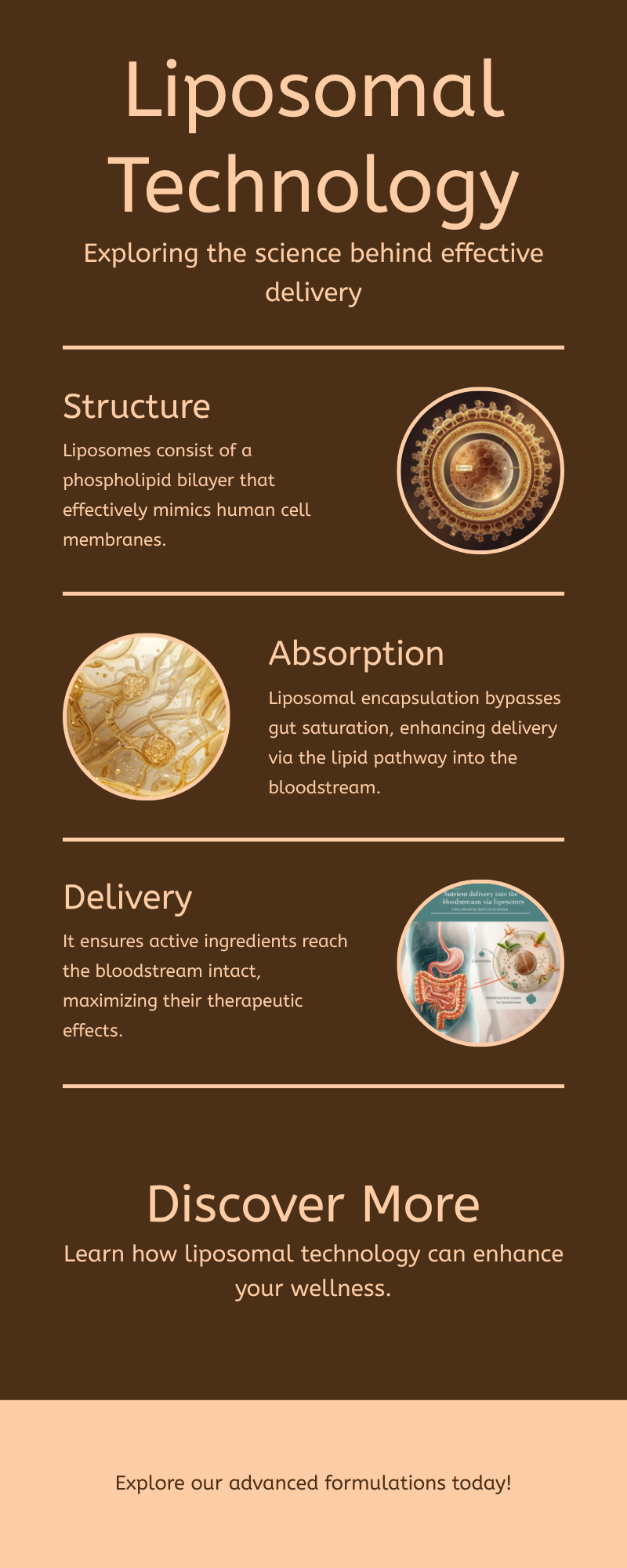
A liposome is a microscopic vesicle — typically 50 to 500 nanometres in diameter — made of one or more phospholipid bilayers identical in structure to the membrane of every human cell. The phospholipid molecule has a water-loving (hydrophilic) head and two water-hating (hydrophobic) tails. In water, these molecules spontaneously self-assemble into spheres, with tails tucked inward and heads facing outward.
Inside the sphere is an aqueous core. That’s where we put water-soluble actives like vitamin C, glutathione, or NAD+. Lipid-soluble actives (vitamin A, D, E, K, curcumin, CoQ10) sit in the bilayer itself.
“`
Aqueous core
(vitamin C, etc.)
↓
░░░░░░ phospholipid bilayer ░░░░░░
│││││││ │││││││
hh-tt tt-hh ← polar head + non-polar tail
hh-tt tt-hh
░░░░░░░░░░░░░░░░░░░░░░░░░░░░
“`
Because the liposome’s exterior is chemically identical to human cell membranes, the gut wall doesn’t reject it — it fuses with it or absorbs it via passive diffusion through the lipid pathway. This bypasses the active transporters that limit conventional vitamin absorption.
The bioavailability problem with conventional supplements
Vitamin C is the textbook example. Sodium-dependent vitamin-C transporters (SVCT1 and SVCT2) in the gut wall saturate at around 200–400 mg per dose. Beyond that, additional vitamin C is mostly excreted unchanged in the urine. Take 5 g of plain ascorbic acid and your plasma concentration plateaus close to the same level as 500 mg.
Glutathione is even worse: oral glutathione is largely broken down in the gut to its constituent amino acids before it reaches the bloodstream. Plasma glutathione barely moves after a standard oral dose.
Curcumin is famously poorly absorbed — under 1% bioavailability for plain curcumin powder, even in fat-rich meals.
For each of these, liposomal encapsulation changes the calculus.
The evidence
- Liposomal vitamin C — Davis et al. (Nutrition and Metabolic Insights, 2016) compared 4 g of liposomal vitamin C against 4 g of plain ascorbic acid in a randomised crossover study. Liposomal peak plasma concentration was significantly higher and the AUC (area under the curve, total exposure) was nearly double.
- Liposomal glutathione — Sinha et al. (European Journal of Clinical Nutrition, 2018) found a 35% increase in whole-blood GSH after 4 weeks of 500 – 1,000 mg/day liposomal glutathione, with parallel improvements in oxidative-stress markers.
- Liposomal curcumin — multiple studies demonstrate 5- to 20-fold higher plasma curcumin with liposomal vs unformulated curcumin, comparable to or better than other enhanced-bioavailability formulations.
References to the underlying papers are listed at the bottom of this page.
What Lynnity puts in liposomes
We currently compound the following actives in liposomal form:
Vitamins
- Liposomal Vitamin C (with 10 botanical flavour variants: acerola, banana, kurma, lemon-lime, mangosteen, pineapple, pink guava, red dragon fruit, soursop)
- Liposomal Vitamin A
- Liposomal Vitamin B Complex
- Liposomal Vitamin B12 (cyanocobalamin)
- Liposomal Vitamin B6 (pyridoxine)
- Liposomal Vitamin B3 (niacin / nicotinamide)
- Liposomal Vitamin D3
- Liposomal Vitamin E
Minerals & cofactors
- Liposomal Mineral Complex
- Liposomal CoQ10
- Liposomal Glutathione
- Liposomal Tocotrienol
Botanicals
- Liposomal Curcumin
- Liposomal Ginkgo Biloba
- Liposomal Resveratrol
Amino acids & peptides
- Liposomal Collagen Peptide
How we make a liposome
Lynnity’s liposome formulation process follows industry-standard methods:
- Phospholipid selection. We use pharmaceutical-grade phosphatidylcholine derived from non-GMO sunflower or soy lecithin. Each batch comes with a Certificate of Analysis.
- Hydration. The phospholipid is dispersed in an aqueous phase containing the active ingredient.
- Size reduction. Sonication or microfluidisation reduces vesicle size to a target range (typically 100–250 nm).
- Quality control. Each batch is checked for particle size distribution, zeta potential (a stability indicator), encapsulation efficiency, and microbial limits.
- Stabilisation. The finished liposomal product is packaged in airless or amber containers to protect from oxidation and light.
Are liposomal supplements safe?
The phosphatidylcholine used in liposomes is GRAS-classified (Generally Recognized as Safe) by the US FDA. It has decades of clinical use in pharmaceutical injectables (Doxil for cancer chemotherapy, Visudyne for AMD) and oral nutraceuticals.
People with severe soy allergy should choose sunflower-derived lecithin formulations — we stock both. People with phenylketonuria (PKU) should review the full ingredient list as some flavoured versions contain aspartame; we have aspartame-free options.
Frequently asked questions
What is liposomal encapsulation?
Liposomal encapsulation wraps an active ingredient — a vitamin, mineral, amino acid, or drug — in a microscopic phospholipid bilayer that mimics the structure of human cell membranes. This protects the active from breakdown in the stomach and increases its absorption in the small intestine.
Why is liposomal vitamin C more bioavailable than regular vitamin C?
At doses above ~200 mg, intestinal absorption of standard vitamin C drops sharply because the transporters become saturated. Liposomal vitamin C bypasses the saturation: the phospholipid carrier ferries vitamin C through the gut wall via lipid pathways, raising plasma concentrations meaningfully higher than equivalent oral ascorbic acid doses (Davis et al., Nutrition and Metabolic Insights, 2016).
Which Lynnity products use liposomal technology?
Liposomal Vitamin C (in 10 fruit-flavoured variants), Liposomal Glutathione, Liposomal CoQ10, Liposomal Curcumin, Liposomal Ginkgo Biloba, Liposomal Resveratrol, Liposomal Collagen, and the Liposomal Vitamin B-complex range — all compounded in Lynnity’s Kuala Lumpur GMP laboratory.
Is liposomal encapsulation safe?
Yes. The phospholipids used (phosphatidylcholine, typically derived from soy or sunflower lecithin) are GRAS-classified (Generally Recognized as Safe) by the US FDA and have decades of use in pharmaceutical injectables and oral supplements.
Can I take liposomal supplements with food?
Yes. Liposomal supplements absorb well with or without food. Some patients prefer to take them on an empty stomach to maximise gut transit speed; others find any GI sensitivity is reduced when taken with food. Either approach works.
Do liposomal supplements need refrigeration?
Most Lynnity liposomal liquid products are stable at room temperature (below 25 °C) for the labelled shelf life. Once opened, refrigeration is recommended and the product should be used within the period specified on the label. Capsule formulations do not require refrigeration.
References
- Davis JL, et al. “Liposomal-encapsulated ascorbic acid: influence on vitamin C bioavailability and capacity to protect against ischemia-reperfusion injury.” Nutrition and Metabolic Insights. 2016. PMC11519160.
- Sinha R, et al. “Oral supplementation with liposomal glutathione elevates body stores of glutathione and markers of immune function.” European Journal of Clinical Nutrition. 2018;72:105–111.
- Łukawski M, et al. “New oral liposomal vitamin C formulation: properties and bioavailability.” Journal of Liposome Research. 2020;30(3):227–234.
- Allen TM, Cullis PR. “Liposomal drug delivery systems: From concept to clinical applications.” Advanced Drug Delivery Reviews. 2013;65(1):36–48.