
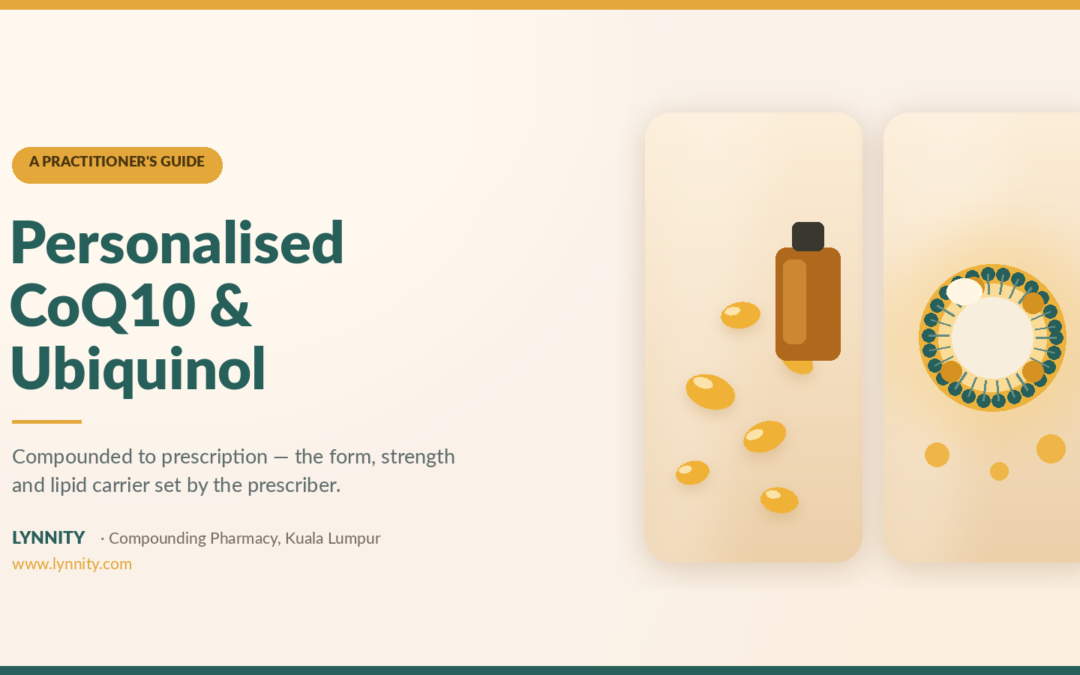
Short answer: Coenzyme Q10 (CoQ10) is a fat-soluble compound the body makes itself and uses in the mitochondrial machinery that generates cellular energy. It exists in two interconverting forms – ubiquinone (oxidised) and ubiquinol (reduced) – and the argument over which to prescribe is, on the evidence, less important than two things practitioners rarely get to control off the shelf: the dose and the lipid base it is dissolved in. Oral CoQ10 is poorly absorbed because the molecule is large and essentially insoluble in water, so formulation quality frequently matters more than the ubiquinol-versus-ubiquinone label. In Malaysia, CoQ10 is one of the most commonly recommended supplements – pharmacists routinely raise it with patients on statins – but retail products come in fixed strengths, in whatever oil or powder base the manufacturer chose, and none is registered to treat, cure or prevent any disease. Lynnity’s role is narrower and different, and it sits exactly where CoQ10’s weakness is: we build liposomal supplement formulations and specialised creams. For CoQ10 that means an oral liposomal preparation whose phospholipid carrier is built with ultrasonic technology, or a topical preparation in our skin-identical lipid cream base – the form, strength, carrier and excipient profile set by the prescribing doctor, prepared only on a prescription from a registered doctor, under the Ministry of Health’s Good Compounding Practice (GCP) guideline.
CoQ10 is unusual among supplements in that clinicians, not marketers, drove its popularity. Cardiology and general practice across Kuala Lumpur, the Klang Valley and Singapore see it raised weekly, most often in the context of statin therapy, fatigue, fertility work-ups and cardiometabolic care. This guide is written for prescribers and referring practitioners: what the evidence actually supports, why absorption is the crux, and where a prescription-led compounding pharmacy adds something a retail bottle cannot.
Why CoQ10 comes up so often in clinic
CoQ10 sits in the inner mitochondrial membrane, shuttling electrons along the respiratory chain – the final steps by which cells turn fuel into usable energy. It also behaves as a lipid-soluble antioxidant within membranes and lipoproteins. Tissues with the highest energy demand, particularly cardiac muscle, carry the highest concentrations.
Two observations drive most clinical interest. First, endogenous CoQ10 production appears to decline with age. Second, statins inhibit HMG-CoA reductase, an enzyme upstream of both cholesterol and CoQ10 synthesis, and circulating CoQ10 levels fall measurably during statin therapy. That biochemistry is not disputed. What remains genuinely unsettled is the clinical consequence: trials of CoQ10 for statin-associated muscle symptoms have produced mixed results, with some showing improvement in symptom scores and others showing none. Many patients report feeling better; the controlled evidence is inconsistent, and it would be dishonest to present it otherwise.
The reasonable practitioner position, and the one this article takes, is that CoQ10 is a plausible, well-tolerated adjunct that some patients appear to benefit from, prescribed on individual assessment – not a treatment for any condition, and not something to promise.
The real problem: almost none of it is absorbed
CoQ10’s practical weakness is pharmacokinetic rather than pharmacological. The molecule is large and lipophilic, with negligible water solubility, and oral bioavailability is widely described as very low – on the order of a few per cent of the administered dose. Several consequences follow, and they matter more than most product labelling suggests.
Absorption is dose-limited, so a single large dose is absorbed less efficiently than the same total split across the day; this is why higher regimens are conventionally divided into two or three doses. Absorption is also strongly fat-dependent – CoQ10 taken with a meal containing fat reaches substantially higher plasma levels than the same dose taken fasted, which makes patient counselling on timing as consequential as the number on the bottle. And the carrier does much of the work: comparative bioavailability studies in healthy adults have repeatedly found that lipid-based, solubilised or micronised preparations outperform plain crystalline powder in a capsule, sometimes by a wide margin. A dry powder of CoQ10 must first dissolve in intestinal lipid before it can be absorbed at all – a step a well-designed oil-based formulation has already done.
The practical implication for prescribers is uncomfortable but useful: two products stating the same milligram strength on the label can deliver very different plasma exposures. Strength alone is a poor proxy for what the patient actually receives.
Ubiquinol versus ubiquinone: what the evidence supports
This is the question patients ask most, and the honest answer is more measured than the marketing.
Ubiquinone is the oxidised form; ubiquinol is the reduced, antioxidant-active form. Ubiquinol is often marketed as the “active” or “already converted” version. Two points deserve emphasis. Pharmacokinetic work does show an absorption advantage for ubiquinol, and it appears largest in older adults – one frequently cited study in adults aged 65 and over reported roughly double the plasma CoQ10 response compared with an equivalent ubiquinone dose. In younger, healthy adults the reported gap is considerably narrower. At the same time, the two forms interconvert continuously in the body, and the great majority of CoQ10 circulating in plasma is present as ubiquinol within hours regardless of which form was swallowed. The body is doing the conversion either way.
Taken together, the sensible reading is that ubiquinol is a reasonable preference in older patients, in those with impaired absorption, and where higher plasma levels are the objective – while formulation quality and dosing schedule often influence the outcome at least as much as the choice of form. Both deserve a prescriber’s attention; only one of them tends to be marketed.
Where compounding changes the conversation
Retail CoQ10 comes in a handful of fixed strengths, in a manufacturer-selected base, with a manufacturer-selected excipient list. A prescription-led compounding pharmacy addresses precisely the variables above.
Dose granularity and titration
Because absorption is dose-limited and split dosing is often preferred, the prescriber may want a strength that no retail product offers, or a schedule built around divided doses. A compounded preparation is made to the strength the doctor specifies, which makes genuine titration over a course possible rather than approximating with fractions of commercial capsules.
The liposomal option – built with sound, not stirred
This is where Lynnity’s core capability meets a fat-soluble molecule. Rather than accepting whatever base a manufacturer used, the prescriber can specify a liposomal preparation in which the CoQ10 sits within a phospholipid bilayer resembling the body’s own membranes.
How that liposome is made is the part that distinguishes a compounded preparation from a bottle labelled “liposomal”. We build ours with ultrasonic technology – high-frequency sound waves create and collapse microscopic cavities in the lipid dispersion, and those micro-implosions shear the lipid into small, uniform vesicles. Vesicle size and uniformity are a direct function of the energy applied, which is an energy density mechanical mixing does not reach. Not stirred, not blended: cavitation. The process is designed to produce a consistent, reproducible vesicle population; we describe what the technology does, and we do not attach an absorption figure or a health outcome to it.
The specialised cream route for topical CoQ10
CoQ10 is also prescribed topically, and a cream is not a lesser version of a capsule – it is a different formulation problem, and specialised creams are Lynnity’s other core strength. A lipophilic active has to cross a lipid barrier, so the base does most of the work. Ours is a skin-identical lipid system, built from the same lipid families the skin barrier is itself made of. Conventional penetration enhancers work by disrupting that lipid matrix to force passage, which is a common source of irritation; a skin-identical system is instead recognised by the barrier and integrates with its lamellar structure – not a solvent forcing its way in, but a key the skin already knows. Where a prescriber wants CoQ10 topically, at a defined strength, in a base chosen for a particular patient’s skin, that is compounded to the prescription.
Combination with the rest of the regimen
Patients on CoQ10 are rarely on CoQ10 alone. Where a doctor wants it prepared alongside other prescribed components in a single formulation to reduce pill burden and support adherence, that is a compounding decision made to a prescription – with the pharmacy confirming the combination is achievable and appropriate to compound before anything is made.
A defined, clean excipient profile
Retail softgels commonly rely on gelatin shells and a fixed set of carriers, which is a barrier for patients with intolerances or dietary requirements. A compounded preparation allows a lean, defined excipient profile signed off by the prescriber, including alternatives where a gelatin capsule is unsuitable.
Quality and traceability under GCP
Every Lynnity preparation is made and documented under the Ministry of Health’s Good Compounding Practice (GCP) guideline, with defined beyond-use dating and record-keeping. GCP is the compounding-specific quality framework, and it is not the same as GMP, which governs large-scale manufacturing. Lynnity is a compounding pharmacy: we prepare individual, prescription-led formulations for named patients, and we do not mass-produce, contract-manufacture or wholesale products.
Practical points prescribers ask about
A few recurring clinical considerations are worth stating plainly. CoQ10 is generally well tolerated, with mild gastrointestinal upset the most commonly reported effect. The interaction most often raised is with warfarin – CoQ10 is structurally related to vitamin K and a reduced anticoagulant effect has been reported, so patients on warfarin need the prescriber’s explicit assessment and appropriate INR monitoring. Response, where it occurs, is typically described as gradual rather than immediate, which is worth setting out with the patient at the start. And because absorption depends so heavily on dietary fat, counselling on taking the preparation with a fat-containing meal is part of the prescription, not an afterthought.
The practitioner workflow
The path is the same as for any Lynnity formulation. A registered doctor assesses the patient and decides whether CoQ10 is appropriate, in which form, at what strength, in what carrier and on what schedule. That prescription comes to Lynnity; our pharmacists confirm the formulation is achievable and appropriate to compound; and the preparation is made under GCP and dispensed for the named patient. Clinics that do not compound in-house are welcome to discuss the workflow with our pharmacy team first, so achievable strengths, lipid bases, delivery forms and beyond-use dating are clear before the first prescription is written. At no point can a patient – or a clinic – obtain a compounded CoQ10 preparation from Lynnity without that prescription.
Frequently asked questions
Is compounded CoQ10 or ubiquinol available over the counter in Malaysia?
Retail CoQ10 supplements are widely sold, but a Lynnity compounded CoQ10 or ubiquinol preparation is different: it is made to a registered doctor’s prescription, individualised to the patient, and there is no direct-purchase or “no prescription needed” route with us.
Should patients on statins take CoQ10?
Statins do lower circulating CoQ10 levels, which is why the question arises so often, and Malaysian pharmacists frequently raise it. Trial evidence for improving statin-associated muscle symptoms is mixed rather than conclusive. It is a reasonable, well-tolerated adjunct for some patients on individual assessment by the prescribing doctor – not a treatment we claim for any condition.
Is ubiquinol genuinely better than ubiquinone?
Ubiquinol is better absorbed in pharmacokinetic studies, with the largest advantage reported in older adults; in younger adults the gap is narrower. Because the two forms interconvert in the body, formulation quality and dosing schedule often matter as much as the choice of form. The prescriber decides which is appropriate.
Why does the lipid base matter so much?
CoQ10 is fat-soluble and very poorly absorbed from a dry powder. Lipid-based and solubilised preparations consistently outperform plain powder in bioavailability studies, and absorption improves further when the dose is taken with a fat-containing meal. Compounding lets the prescriber specify that carrier rather than inherit it.
Can Lynnity prepare a liposomal CoQ10?
Yes – liposomal supplement formulation is one of our two core capabilities. We build the liposomes in-house with ultrasonic technology: sound waves shear the lipid into small, uniform vesicles rather than mixing them mechanically. The form and strength follow the prescription. We describe what the process does and make no absorption or outcome promise.
Can you compound CoQ10 into a cream?
Yes. Specialised creams are our other core capability. A topical CoQ10 preparation is made in our skin-identical lipid base – built from the lipid families the skin barrier is made of, so it integrates with the barrier rather than disrupting it to force passage. Strength and base are set by the prescriber.
Are there interactions to watch?
The one most frequently raised is warfarin: CoQ10 is structurally related to vitamin K and a reduced anticoagulant effect has been reported, so it requires the prescriber’s assessment and appropriate monitoring. Any patient’s full medication list should be reviewed by the prescribing doctor.
We run a clinic in KL or Singapore – how do we start prescribing through Lynnity?
Contact us through www.lynnity.com and ask to speak with a pharmacist. We can talk through achievable forms, strengths, lipid bases, delivery formats and beyond-use dating before your first prescription is sent.
Reviewed by the Lynnity pharmacy team – registered pharmacists compounding to Good Compounding Practice (GCP) in Kuala Lumpur.
This article is general information for healthcare practitioners and is not medical advice. It does not diagnose, treat or recommend therapy for any condition. Compounded CoQ10 and ubiquinol preparations at Lynnity are prepared only on a prescription from a registered doctor.
Compounded Liposomal NAD+ Precursors (NMN & NR) in Malaysia: A Practitioner’s Guide for Longevity and Wellness Clinics
NMN and NR are the NAD+ precursors behind the longevity trend, but they absorb inconsistently — which is why a liposomal form is proposed. A practitioner’s guide to compounded, prescription-led liposomal NAD+ precursors for clinics in KL and Singapore.
Compounded DHEA in Malaysia: A Practitioner’s Guide for Hormone, Menopause & Fertility Clinics
DHEA is a steroid hormone the body converts into oestrogen and testosterone, and it is prescription-only in Malaysia. A practitioner’s guide to where clinicians use it — menopause, fertility and andropause — and how dose-precise compounding tailors it for clinics in KL and Singapore.
Compounded Liposomal Glutathione: A Practitioner’s Guide for Clinics in Malaysia
Glutathione is the body’s principal antioxidant, but plain oral capsules are poorly absorbed and the injectable “whitening” versions sold in the region are largely unlicensed in Malaysia. A practitioner’s guide to where oral, prescription-led liposomal glutathione fits for clinics in KL and Singapore.